
Every AI pilot has a great week. It's usually the week of the demo.
The model answers the CEO's question perfectly. Someone says "imagine this across the whole company." A Slack channel gets created. And then, quietly, around month four, the thing stops showing up in status meetings. Nobody kills it. It just stops mattering.
If that sounds familiar, you're in very large company. The research from the last eighteen months is blunt about it, and once you line the numbers up next to each other, a pattern shows up that has very little to do with which model you picked.
The numbers, without the hype
In mid-2025, MIT's NANDA initiative published The GenAI Divide, built on 150 interviews with leaders, a survey of 350 employees and an analysis of 300 public AI deployments. The headline finding: about 95% of enterprise generative AI pilots delivered no measurable impact on the P&L. Roughly 5% produced fast, real revenue gains.
That number got argued about a lot (and fairly, since "measurable P&L impact" is a high bar for a six-month pilot). So look at what everyone else found:
McKinsey's State of AI 2025 (1,993 respondents, 105 countries): 88% of organizations now use AI in at least one function. Only 39% report any EBIT impact, and most of those say it's under 5% of EBIT. Just ~6% qualify as "high performers."
S&P Global Market Intelligence (1,000+ respondents, North America and Europe): 42% of companies abandoned most of their AI initiatives in 2025, up from 17% the year before. The average company scrapped 46% of its proofs-of-concept before production.
Gartner predicted in 2024 that at least 30% of GenAI projects would be abandoned after proof of concept by the end of 2025, and in June 2025 said over 40% of agentic AI projects will be cancelled by the end of 2027.
RAND, after interviewing 65 experienced data scientists and engineers, notes estimates that more than 80% of AI projects fail, about twice the rate of regular IT projects.
Different methods, different years, same shape.
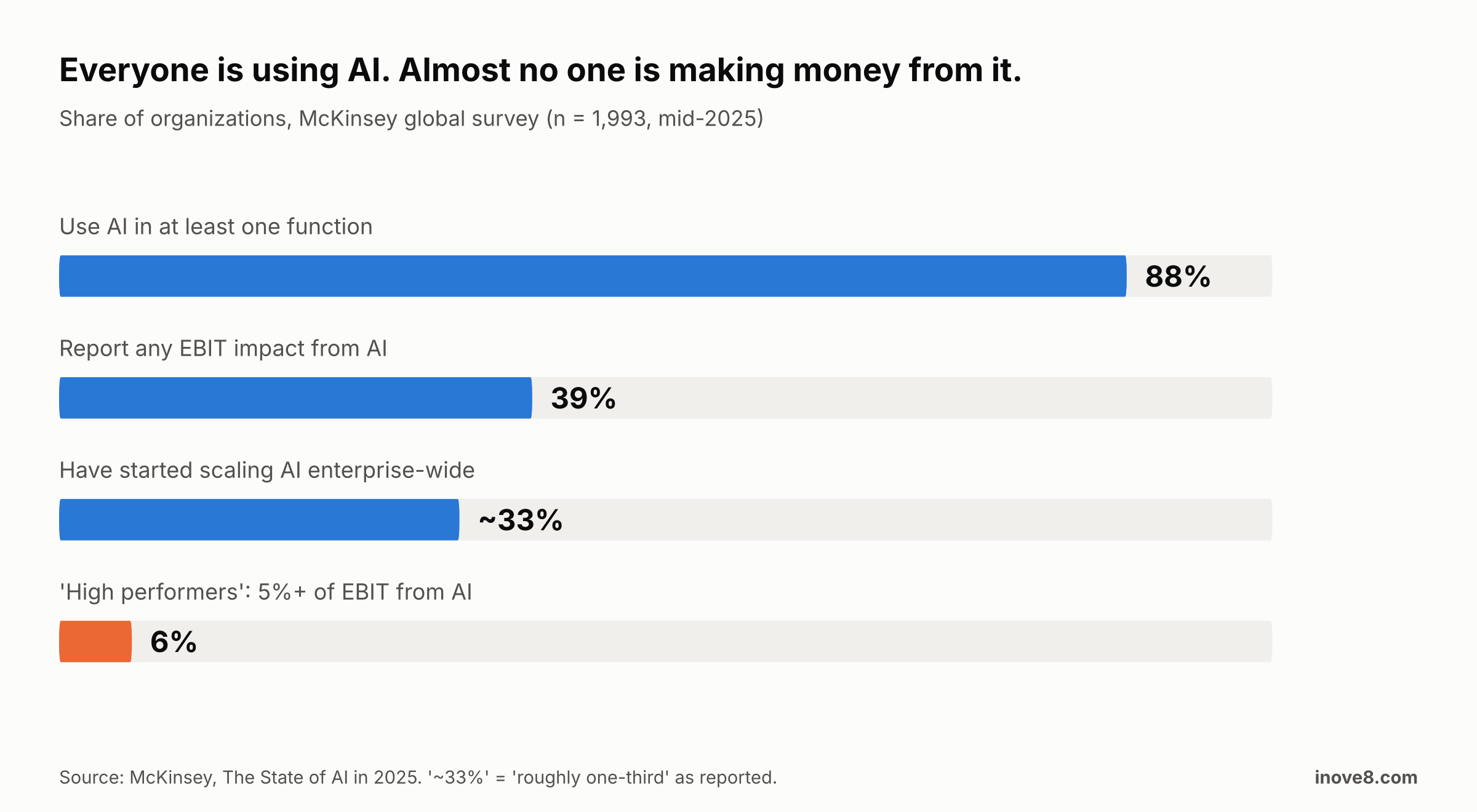
Read that chart from top to bottom and you get the real story of enterprise AI right now. Adoption is basically solved. Value is not. The gap between the first bar and the last one is where most AI budgets go to die.
It's not the model. It's almost never the model.
Here's the uncomfortable bit. When RAND asked practitioners why AI projects fail, none of the five root causes they found was "the model wasn't smart enough." They were:
People misunderstood or miscommunicated what problem the AI was supposed to solve.
The organization didn't have the data needed to train or ground the system.
The team chased the newest technology instead of a real problem users had.
The infrastructure to manage data and deploy models wasn't there.
The problem was simply too hard for current AI.
Four out of five are management and engineering problems. Only one is about the limits of AI itself. MIT's researchers landed in a similar place: the main issue wasn't model quality, it was a "learning gap." Generic tools are great for individuals because they're flexible, but they stall inside companies because they don't learn from or adapt to the company's actual workflows.
A pilot proves the AI can do the task. Production proves your business can absorb it. Those are two completely different tests, and most teams only prepare for the first one.
Abandonment is speeding up, not slowing down
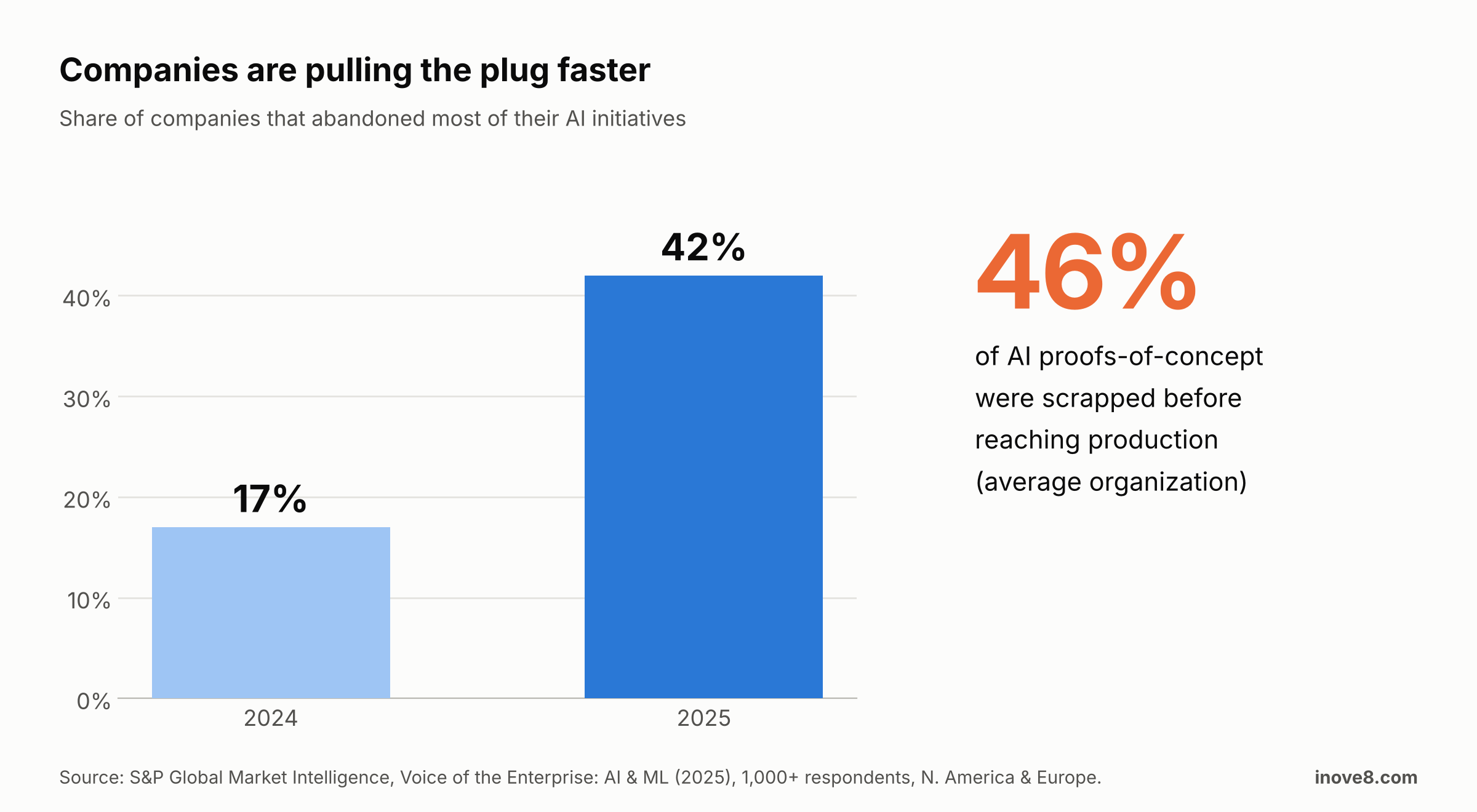
You'd expect failure rates to drop as tools mature. They went the other way. The likely reason is simple: 2024 was the year of cheap experiments, and 2025 was the year finance started asking what they bought. S&P's respondents named cost, data privacy and security as their biggest obstacles. None of those show up in a demo. All of them show up in production.
Gartner adds another warning for anyone shopping for "agents" right now. It estimates that of the thousands of vendors selling agentic AI, only about 130 are the real thing. The rest is what Gartner calls "agent washing," which means rebranding chatbots, RPA and assistants with a new label.
So what do the 5% actually do differently?
Pulling the research together, the winners aren't using secret models. They make a handful of boring, disciplined choices. Seven of them come up again and again.
1. They redesign the workflow, not just add a tool
This is the clearest signal in McKinsey's data: AI high performers are nearly three times as likely to have fundamentally redesigned individual workflows. Dropping a copilot into a broken process gives you a faster broken process. The winners ask "if we built this job from scratch today, with AI in it, what would it look like?" and then rebuild it.
2. They point AI at the back office first
MIT found that more than half of GenAI budgets go to sales and marketing tools, yet the biggest returns showed up in back-office automation: finance ops, procurement, document processing, customer service operations. It isn't glamorous. It's measurable, though, and measurable is what gets a second round of funding.
3. They partner instead of going it alone
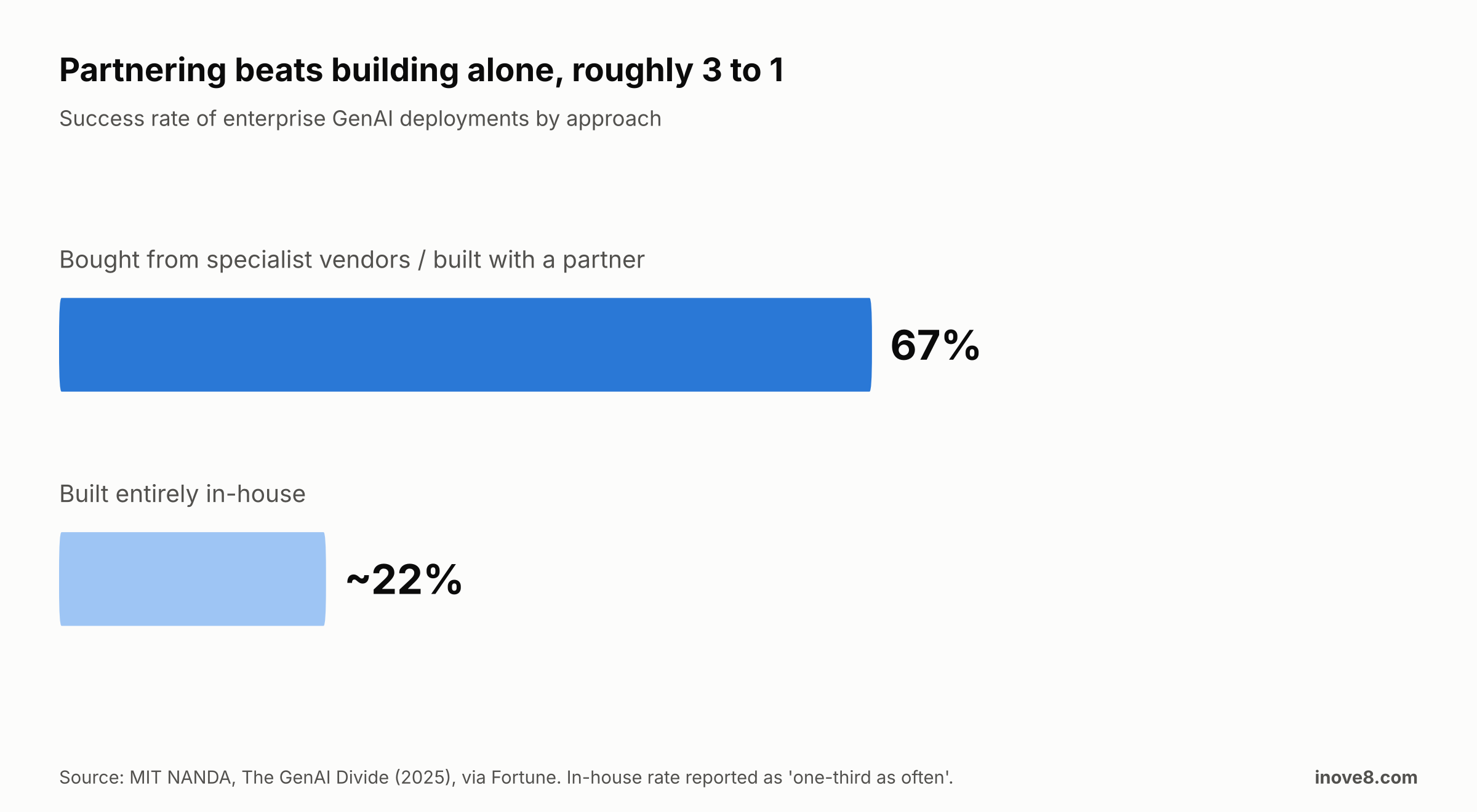
This one surprises people. According to MIT, solutions bought from specialist vendors or built with partners succeeded about 67% of the time. Pure internal builds succeeded about one-third as often. Internal teams aren't less talented. The difference is that a partner who has shipped the same pattern ten times already knows where the data pipeline breaks, what the security review will flag and which evaluation metrics actually predict success.
4. They define "done" in rupees or dollars before writing code
"Improve productivity" isn't a success metric. "Cut invoice processing time from 4 days to 1 and reduce manual touches by 60%" is. If you can't write the business metric on a sticky note before the pilot starts, you won't be able to defend the project when the budget review comes.
5. They fix the data before they pick the model
Data shows up in RAND's root causes and in Gartner's reasons for abandonment. Teams that win spend the unsexy first weeks on access, quality, permissions and lineage. A mediocre model on clean, well-governed data beats a frontier model on a messy SharePoint folder every time.
6. They plan for production on day one
Monitoring, evals, cost per request, fallback behaviour, audit logs, access control. If these show up for the first time in month five, the pilot will stall in month five. Successful teams build a thin but real production path from the start, even if the first version only serves 20 users.
7. They give it a business owner, not just a tech owner
Pilots owned only by IT or a data science team tend to optimise for accuracy. Pilots owned by the head of the function that uses them optimise for adoption. Adoption is what moves the P&L.
A 10-minute test before you fund your next AI pilot
Run this before any build starts. Score one point for each "yes":
Can you name the one business metric this pilot should move, with a target number?
Is there a named business owner (not just a tech lead) who will use it every week?
Do you already have access to the data it needs, with the right permissions?
Have you mapped how the workflow will change, not just where the AI plugs in?
Is there a budget line for running it in production, not just building it?
Do you know how you'll measure quality after launch (evals, human review, error rates)?
Has security and compliance seen the design before the build, not after?
Is the problem narrow enough to ship something useful in 8–12 weeks?
7–8: fund it. 4–6: fix the gaps first; it's cheaper now than in month five. 0–3: you have an experiment, not a project. That's fine, just budget and label it as one.
The bottom line
The 95% number is scary, but it's also good news, because it tells you the failures are mostly avoidable. The companies getting real returns from AI aren't smarter or luckier. They pick narrower problems, fix their data, redesign the work around the tool and bring in people who've done it before.
The demo is the easy part. The interesting work starts the week after.
If you're sitting on a pilot that looks great in demos but hasn't moved a business number yet, talk to the Inove8 team. We'll tell you honestly whether it's worth scaling, fixing or shelving.
Sources
MIT NANDA, The GenAI Divide: State of AI in Business 2025 (via Fortune)
McKinsey, The State of AI in 2025: Agents, innovation, and transformation
Gartner: Over 40% of agentic AI projects will be canceled by end of 2027
Gartner: 30% of GenAI projects abandoned after proof of concept by end of 2025
RAND, The Root Causes of Failure for Artificial Intelligence Projects (2024)